Master Your First Engineering Job: What Companies Actually Expect from Day 1 to 6 Months
By: Ishika Bhatt
Updated on: March 2026
8 Mins to read
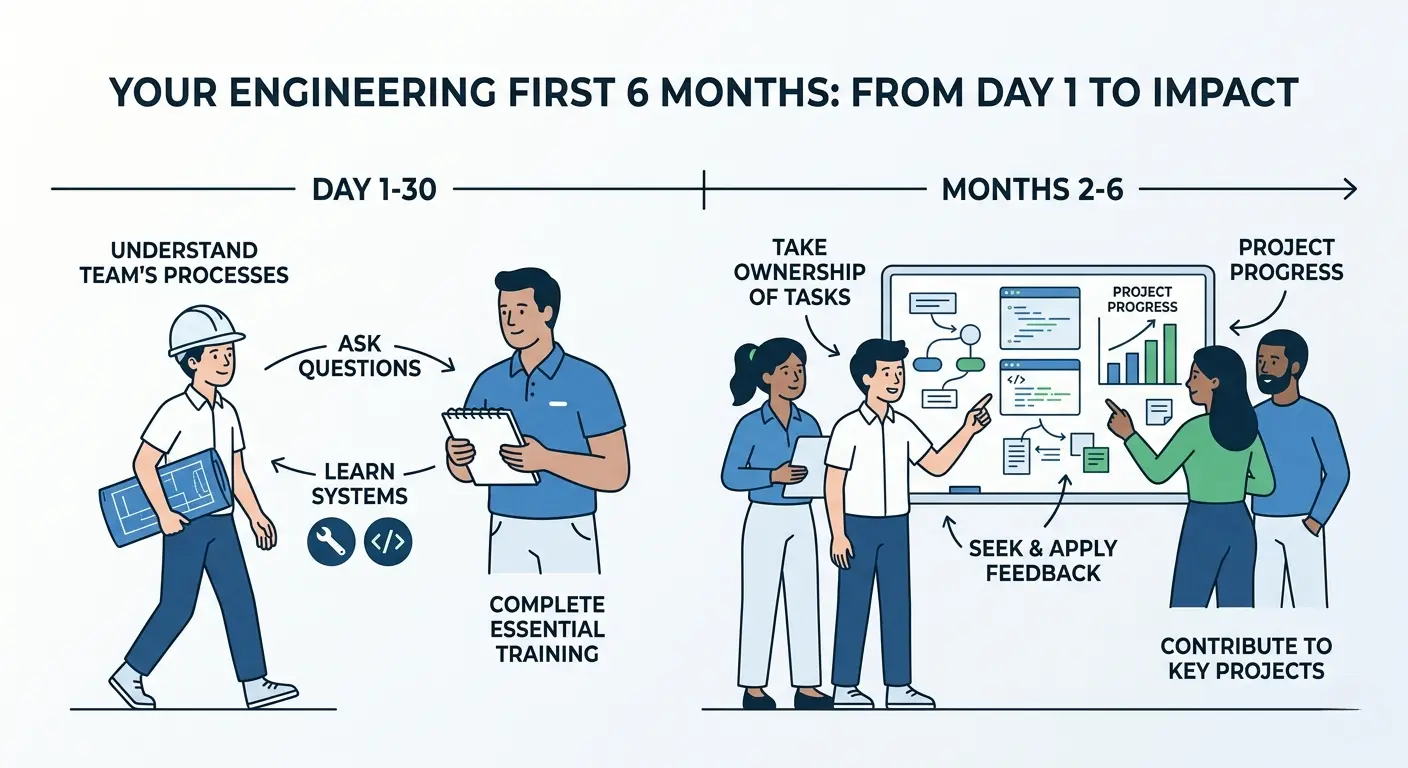
Walking into your first job in the industrial hubs of Vadodara feels like stepping onto a different planet.
One day you are a student worrying about CGPA, and the next, you are an “Engineer” responsible for machines worth crores.
While your degree is a valuable entry ticket, the industry plays by a different set of rules.
To help you bridge the gap between “Campus to Cabin,” We listed the hidden rules your boss wants you to follow.
Day 1: Be Disciplined and Observe
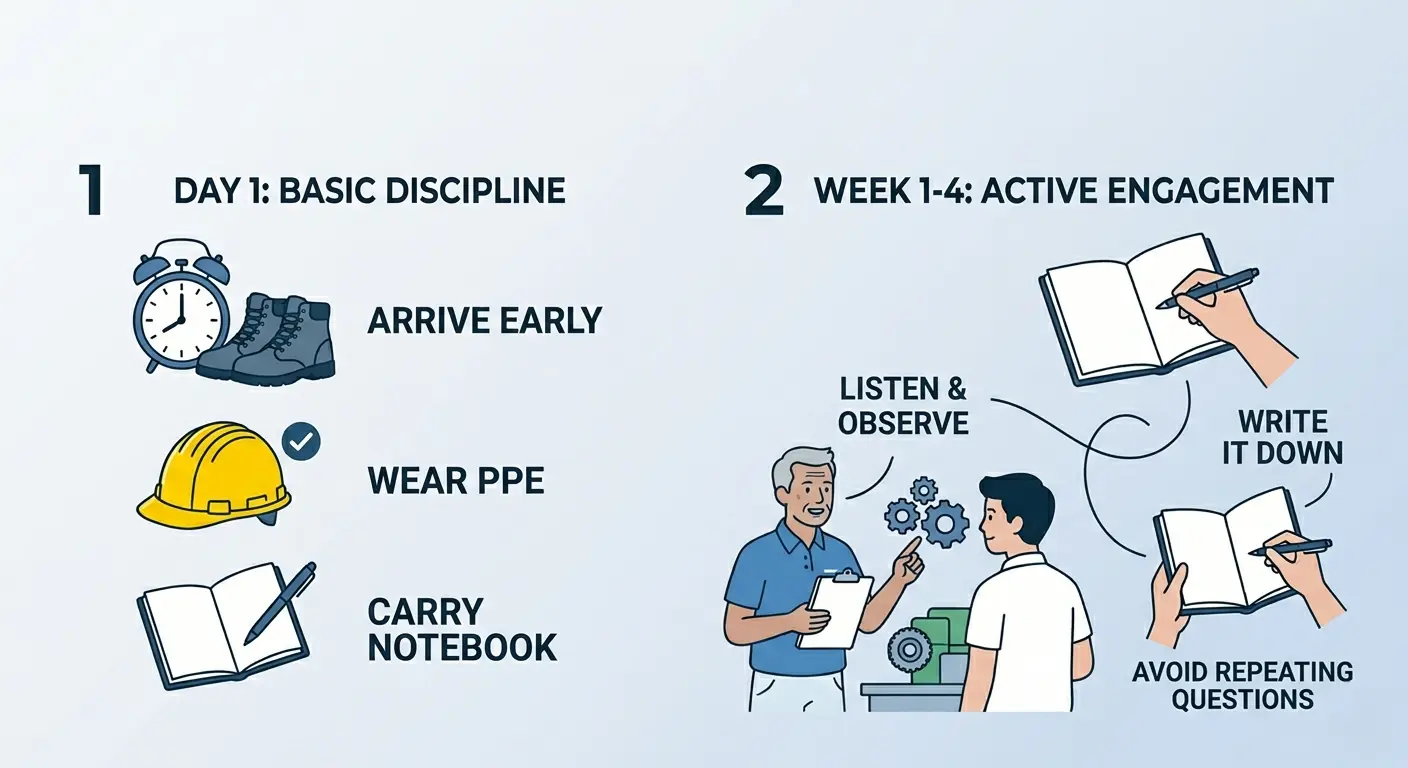
On your first day, nobody expects you to be a genius. They are looking at your habits.
- The Time Rule: In the engineering world, “on time” means being there 10 minutes early. If the factory shift starts at 9:00 AM, being there at 9:10 AM is a bad start.
- Safety First: In GIDC areas like Makarpura, safety is everything. Wear your safety shoes and helmet without being told. It shows you are serious and responsible.
- Carry a Notebook: Carry a small notebook everywhere. When a senior explains how a machine works or how to fill out a report, write it down. If you ask the same question again and again, it looks like you aren’t paying attention.
The First Month: Learn the "Real" Work
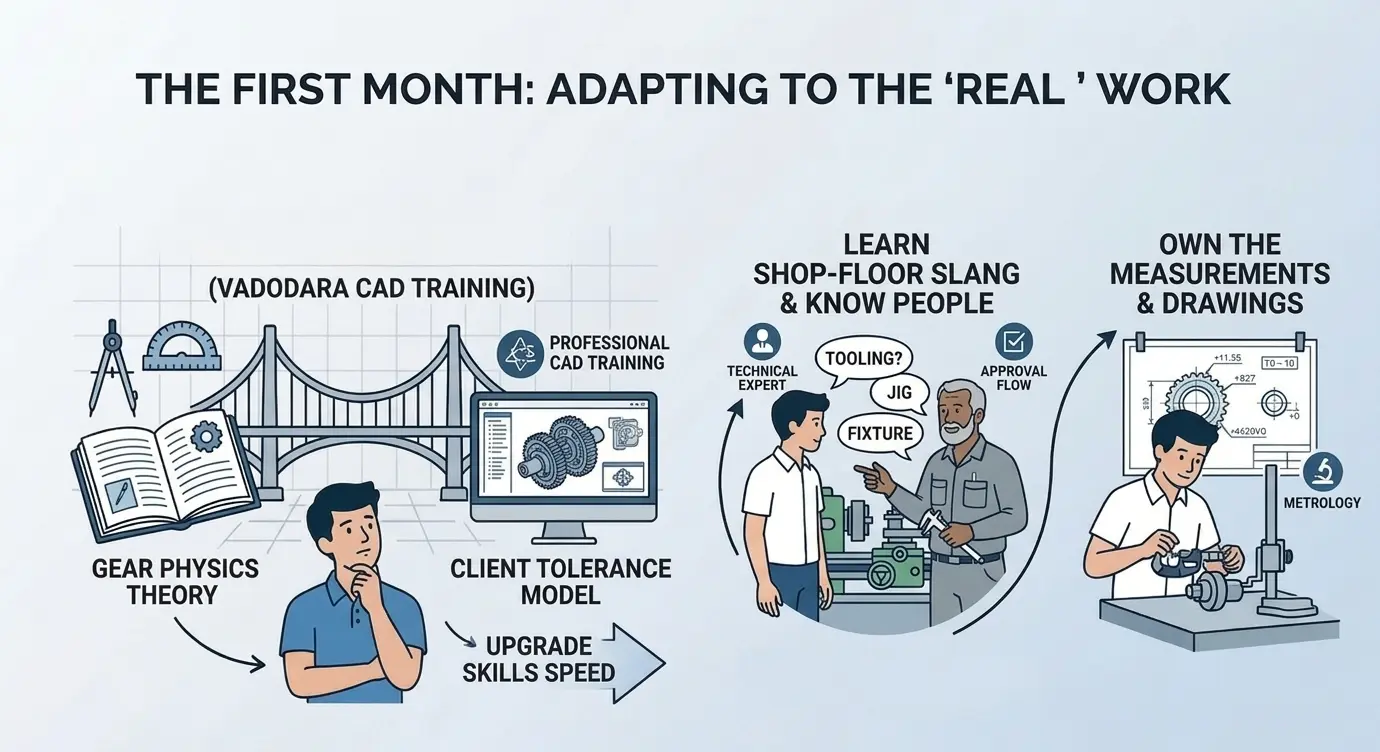
By the end of your first 30 days, the “newcomer” period is over. Now, the expectation shifts to how quickly you can adjust to the company’s technical workflows.
This is the phase where you realize that theory and practice are like “dur ke rishtedar.” You might know the physics of a gear, but do you know how to model it with the exact tolerances required by the client? Many new engineers realize their college skills aren’t fast enough, which is why they often look for professional CAD Training in Vadodara to match the speed with the senior design team.
During this month, you should:
- Master the Slang: Learn the local shop-floor terms for tools, materials, and processes.
- Understand and know the people: Know who to go to for technical help (the “Master” or Technician) and who to go to for management approvals.
- Own the Basics: Be comfortable reading complex industrial drawings and using basic measuring instruments like digital micro meters and height gauges without handholding.
The 6-Month Mark: The "Independent Contributor"
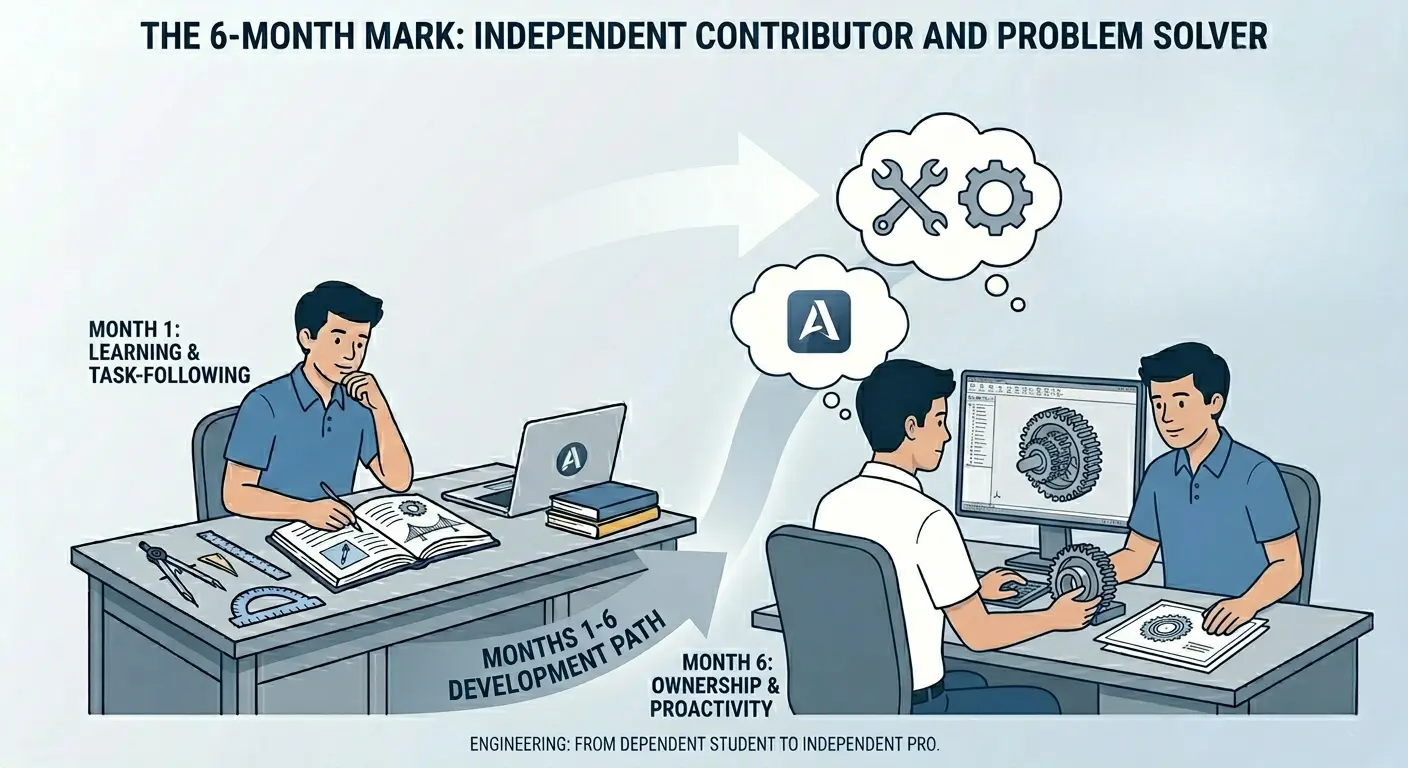
After six months, the training wheels are gone. Your manager now expects you to be a Problem Solver. not just a task-follower.
At this stage, you are expected to handle a small “module” or project independently. You should be able to spot a mistake in a design before it goes to production. For those in design roles, this usually means being a Pro at software like SolidWorks or Creo. If you find yourself struggling to keep up with the drafting speed of the unit, investing in professional CAD Training in Vadodara can give you that boost in productivity that managers look for during your first performance review.
By month six, the industry expects:
- Ownership: If a task is assigned to you, you ensure it is done correctly and on time. You don’t wait for a reminder.
- Reliability: Your boss can trust your data and your drawings. You have developed a “double-check” habit.
- Resourcefulness: Instead of just reporting a problem, you bring two ideas on how to fix it on your senior’s table.
Why Experience Matters More Than a Degree
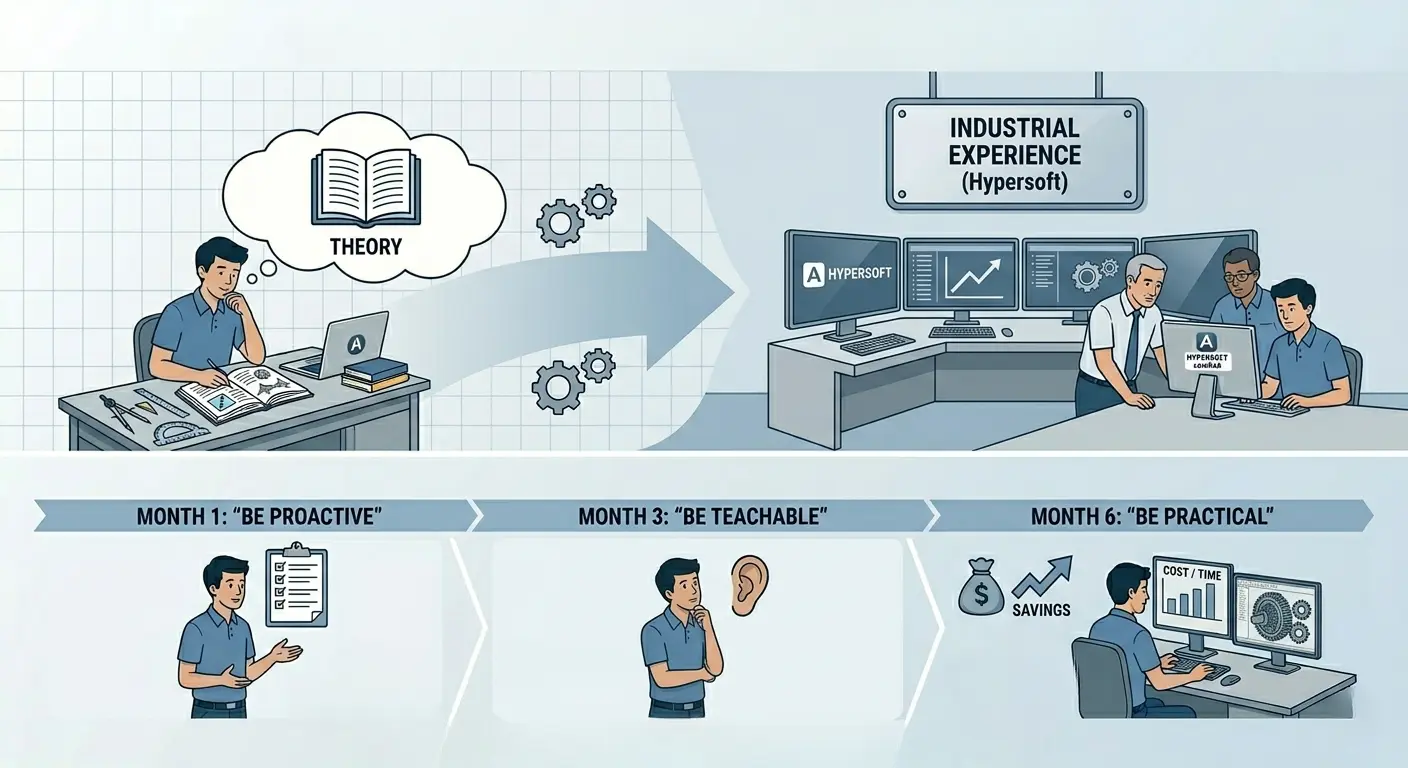
Colleges teach you “what” to think, but the industry demands you know “how” to work smoothly under pressure. The reality is that Baroda’s engineering market is highly competitive. Firms like L&T, ABB, and Siemens are looking for engineers who can start working immediately.
This is why many successful freshers learn extra skills outside of college. Whether it is learning about PLC automation or taking a structured CAD Training in Vadodara, the goal is to reduce your “Progress function” so that you become an asset to the company as fast as possible.
Taking the Next Step with Hypersoft
To truly stand out, you need to bridge the gap between classroom theory and factory reality. Hypersoft is the leading center for CAD Training, offering hands-on experience that mirrors real-world industrial projects.
By training with us, you don’t just learn software, you learn the precision and speed that top Baroda engineering firms demand from day one.
Conclusion: Your 3-Point Success Plan
To do well in your first six months, remember these three simple things:
- Be Proactive: Don’t wait for work, look for it. If your desk is clear, ask the senior if you can help with their BOM (Bill of Materials) or site report.
- Be Teachable: Leave your ego at the gate. Even the person cleaning the CNC machine knows something about the process that you don’t.
- Be Practical: Focus on “Cost and Time.” Every design or process change you suggest should either save the company money or save them time.
Engineering is 20% what you know and 80% how you apply it. Start observing, keep learning, and you’ll find that the “piece of paper” degree slowly turns into a powerful, high-paying career.
FAQ's
How do I know if my CAD speed is good enough for a job?
If a senior takes 20 minutes to model a part and you take 60, you need more practice. Aim to complete industrial drawings in under half the time it took you as a student.
What is more important in the first 6 months: Innovation or Reliability?
Reliability. Before you try to “change the system,” prove that your drawings are 100% accurate and your data can be trusted without a second check.
What "shop-floor" habit makes a fresher stand out the most?
The Notebook Habit. Never go to a machine or a meeting without a pen and paper. Writing down technical instructions the first time shows you are reliable and won’t ask the same question twice.